
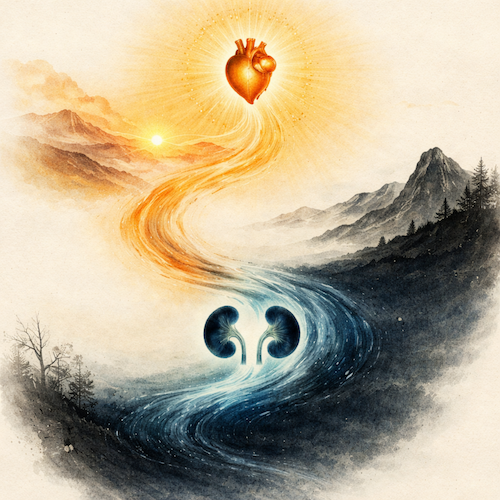
The Emperor and the Root: Heart, Kidneys and the Cost of Burnout
In Chinese medicine, the Kidneys are regarded as the Root of Life and the keepers of the body’s deepest reserves.
If the Heart is the Emperor who governs the realm, the Kidneys are the ancestral treasury and waterways that sustain the entire kingdom from below.
Chinese medicine often describes the body as a hierarchical internal landscape. Each organ has a role within a living system of governance. At the highest level sits the Heart, the Emperor, which houses the Shén (spirit) and provides clarity, direction and meaning. Beneath this visible leadership lies a deeper foundation: the Kidneys, which store Jīng (Essence) and regulate the body’s most fundamental resources.
The Kidneys are sometimes described as the waterways of the body. Just as rivers, reservoirs and underground springs distribute water through a landscape, Kidney energy governs the movement and storage of the body’s fluids and deep vitality. These waterways nourish the organs, moisten the tissues, and maintain balance between the body’s warming and cooling forces.
Within this landscape, the Kidneys store Jīng — the Essence inherited from our parents. This Essence determines growth, development, fertility, resilience and the pace at which we age. Unlike many other forms of energy in the body, Jīng is precious and finite. It can be conserved and supported, but not easily replaced.
This is reflected in the pulses. In classical pulse diagnosis, the Heart pulse should be present at the exterior. The Heart expresses itself outwardly through warmth, joy, connection and relationship. It is through the Heart that we interact with the world, form bonds with others, experience meaning, and manifest the blueprint of our life into reality.
The Kidney pulse, by contrast, should be deep and protected. This depth reflects the protected nature of Jīng. Our deepest reserves are not meant to be constantly exposed or spent. They are meant to be guarded, nourished and drawn upon wisely.
The emotional landscape of the Kidneys reflects this depth. The Kidneys are associated with fear, but also with willpower and determination. Fear alerts us to danger and helps preserve life. Willpower allows us to endure hardship, persevere and move forward despite difficulty.
However, when life is driven primarily by fear, or by sheer willpower and relentless drive, we begin to consume our deepest reserves. Without the guidance of the Heart’s Shén — the clarity, joy and purpose that give direction to life — willpower alone can become exhausting.
In this state, people often achieve much through determination, but at the cost of their own vitality. It requires constant expenditure of Kidney resources to sustain this level of effort.
Over time, this pattern leads to depletion and burnout.
The classical view therefore emphasises harmony between the Heart and Kidneys — often described as the balance between Fire and Water.
The Heart provides vision, joy and meaningful direction.
The Kidneys provide endurance, depth and the reserves needed to sustain life.
When these two work together, life unfolds with both purpose and resilience. The Heart guides the journey, and the Kidneys provide the strength to walk the path without exhausting the very essence that sustains us.
This understanding is not new. It is articulated clearly in Chapter 8 of the Huang Di Nei Jing Suwen, where the body is described as a system of twelve officials, each fulfilling a role within a unified governance:
The Heart acts as the ruler, from which spirit and clarity arise.
The Lungs establish order and regulation.
The Liver plans and strategises.
The Gallbladder makes decisions.
The centre (Dan Zhong) expresses joy and connection.
The Spleen and Stomach transform nourishment.
The Intestines manage transformation and transmission.
The Triple Burner governs the waterways.
The Bladder stores and releases fluids.
And the Kidneys are described as the officials of strength, skill and capacity — the deep reserves that enable all function.
Yet the text makes something very clear:
All twelve officials must remain in communication.
If the ruler — the Heart — is clear and enlightened, the entire system functions in harmony. Life is nourished, pathways remain open, and longevity follows naturally.
But if the Heart loses clarity, the system falls into disorder. Communication breaks down, the pathways become obstructed, and the body begins to deteriorate.
This is the deeper teaching.
The Kidneys may hold the reserves, the strength, the will to endure — but without the guidance of the Heart, those reserves can be misused.
To live well, therefore, is not simply to be driven or resilient.
It is to ensure that the Heart leads, and the Kidneys support.
That our actions are guided by clarity and meaning, rather than fear alone.
That our willpower is aligned with purpose, rather than used to override it.
Because when the Emperor is clear, the kingdom thrives.
And when the waterways are protected, life endures.
The Huang Di NeiJing SuWen: Chapter 8
Huang Di asked:
“I should like to hear [the following]:
How do the twelve depots engage each other, and what is their hierarchy?”
Qi Bo responded:
“an encompassing question, indeed!
Please let me speak about them one by one.
The heart is the official functioning as ruler.
spirit brilliance originates in it.
The lung is the official functioning as chancellor and mentor. order and moderation originate in it.
The liver is the official functioning as general.
Planning and deliberation originate in it.
The gallbladder is the official functioning as rectifier.
Decisions and judgments originate in it.
The dan zhong is the official functioning as minister and envoy. Joy and happiness originate in it.
The spleen and the stomach are the officials responsible for grain storage. The five flavors originate from them.
The large intestine is the official functioning as transmitter along the Way. Changes and transformations originate in it.
The small intestine is the official functioning as recipient of what has been perfected.
The transformation of things originates in it.
The kidneys are the official functioning as operator with force. Technical skills and expertise originate from them.
The triple burner is the official functioning as opener of channels. The paths of water originate in it.
The urinary bladder is the official functioning as regional rectifier. The body liquids are stored in it.
<When the qi is transformed, then [urine] can originate [from there].> all these twelve officials must not lose [contact with] each other.
Hence,
if the ruler is enlightened, his subjects are in peace.
To nourish one’s life on the basis of this results in longevity. There will be no risk of failure till the end of all generations. Thereby ruling the world will result in a most obvious success.
If the ruler is not enlightened, then the twelve officials are in danger. This causes the paths to be obstructed and impassable.
The physical appearance will suffer severe harm.
To nourish life on the basis of this results in calamities.
Thereby ruling the world will greatly endanger the ancestral temple.

Can acupuncture help me?
For the most up-to-date research and evidence on the efficacy of acupuncture, please visit the British Acupuncture Council (BAcC) website.
If you would like to learn more about how acupuncture may be able to help you, please contact us today.